TensorFlow saver指定变量的存取
今天和大家分享一下用TensorFlow的saver存取训练好的模型那点事。
1. 用saver存取变量;
2. 用saver存取指定变量。
用saver存取变量。
话不多说,先上代码
# coding=utf-8
import os
import tensorflow as tf
import numpy
os.environ['TF_CPP_MIN_LOG_LEVEL'] = '2' #有些指令集没有装,加这个不显示那些警告
w = tf.Variable([[1,2,3],[2,3,4],[6,7,8]],dtype=tf.float32)
b = tf.Variable([[4,5,6]],dtype=tf.float32,)
s = tf.Variable([[2, 5],[5, 6]], dtype=tf.float32)
init = tf.global_variables_initializer()
saver =tf.train.Saver()
with tf.Session() as sess:
 sess.run(init)
 save_path = saver.save(sess, "save_net.ckpt")#路径可以自己定
 print("save to path:",save_path)
这里我随便定义了几个变量然后进行存操作,运行后,变量w,b,s会被保存下来。保存会生成如下几个文件:
- cheakpoint
- save_net.ckpt.data-*
- save_net.ckpt.index
- save_net.ckpt.meta
接下来是读取的代码
import tensorflow as tf
import os
import numpy as np
os.environ['TF_CPP_MIN_LOG_LEVEL'] = '2'

w = tf.Variable(np.arange(9).reshape((3,3)),dtype=tf.float32)
b = tf.Variable(np.arange(3).reshape((1,3)),dtype=tf.float32)
a = tf.Variable(np.arange(4).reshape((2,2)),dtype=tf.float32)
saver =tf.train.Saver()
with tf.Session() as sess:

 saver.restore(sess,'save_net.ckpt')
 print ("weights",sess.run(w))
 print ("b",sess.run(b))
 print ("s",sess.run(a))
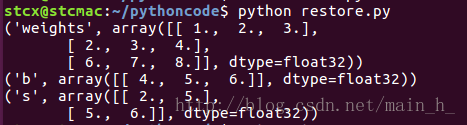
在写读取代码时要注意变量定义的类型、大小和变量的数量以及顺序等要与存的时候一致,不然会报错。你存的时候顺序是w,b,s,取的时候同样这个顺序。存的时候w定义了dtype没有 定义name,取的时候同样要这样,因为TensorFlow存取是按照键值对来存取的,所以必须一致。这里变量名,也就是w,s之类可以不同。
如下是我成功读取的效果
用saver存取指定变量。
在我们做训练时候,有些变量是没有必要保存的,但是如果直接用tf.train.Saver()。程序会将所有的变量保存下来,这时候我们可以指定保存,只保存我们需要的变量,其他的统统丢掉。
其实很简单,只需要在上面代码基础上稍加修改,只需把tf.train.Saver()替换成如下代码
program = []
program += [w,b]
tf.train.Saver(program)
这样,程序就只会存w和b了。同样,读取程序里面的tf.train.Saver()也要做如上修改。dtype,name之类依旧必须一致。
最后附上最终代码:
# coding=utf-8
# saver保存变量测试
import os
import tensorflow as tf
import numpy
os.environ['TF_CPP_MIN_LOG_LEVEL'] = '2' #有些指令集没有装,加这个不显示那些警告
w = tf.Variable([[1,2,3],[2,3,4],[6,7,8]],dtype=tf.float32)
b = tf.Variable([[4,5,6]],dtype=tf.float32,)
s = tf.Variable([[2, 5],[5, 6]], dtype=tf.float32)
init = tf.global_variables_initializer()
program = []
program += [w, b]
saver =tf.train.Saver(program)
with tf.Session() as sess:
 sess.run(init)
 save_path = saver.save(sess, "save_net.ckpt")#路径可以自己定
 print("save to path:",save_path)
#saver提取变量测试
import tensorflow as tf
import os
import numpy as np
os.environ['TF_CPP_MIN_LOG_LEVEL'] = '2'

w = tf.Variable(np.arange(9).reshape((3,3)),dtype=tf.float32)
b = tf.Variable(np.arange(3).reshape((1,3)),dtype=tf.float32)
a = tf.Variable(np.arange(4).reshape((2,2)),dtype=tf.float32)
program = []
program +=[w,b]
saver =tf.train.Saver(program)
with tf.Session() as sess:

 saver.restore(sess,'save_net.ckpt')
 print ("weights",sess.run(w))
 print ("b",sess.run(b))
 #print ("s",sess.run(a))
以上就是本文的全部内容,希望对大家的学习有所帮助,也希望大家多多支持【听图阁-专注于Python设计】。