自适应线性神经网络Adaline的python实现详解
自适应线性神经网络Adaptive linear network, 是神经网络的入门级别网络。
相对于感知器,采用了f(z)=z的激活函数,属于连续函数。
代价函数为LMS函数,最小均方算法,Least mean square。
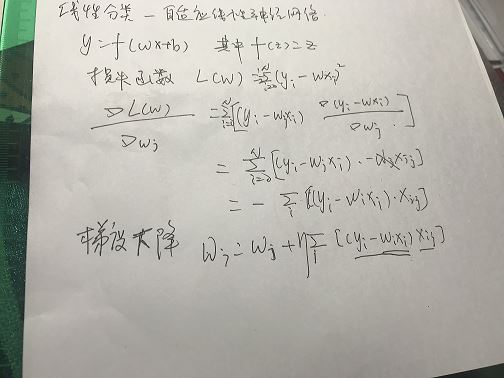
实现上,采用随机梯度下降,由于更新的随机性,运行多次结果是不同的。
'''
Adaline classifier

created on 2019.9.14
author: vince
'''
import pandas
import math
import numpy
import logging
import random
import matplotlib.pyplot as plt

from sklearn.datasets import load_iris
from sklearn.model_selection import train_test_split
from sklearn.metrics import accuracy_score

'''
Adaline classifier

Attributes
w: ld-array = weights after training
l: list = number of misclassification during each iteration
'''
class Adaline:
  def __init__(self, eta = 0.001, iter_num = 500, batch_size = 1):
    '''
    eta: float = learning rate (between 0.0 and 1.0).
    iter_num: int = iteration over the training dataset.
    batch_size: int = gradient descent batch number,
      if batch_size == 1, used SGD;
      if batch_size == 0, use BGD;
      else MBGD;
    '''

    self.eta = eta;
    self.iter_num = iter_num;
    self.batch_size = batch_size;

  def train(self, X, Y):
    '''
    train training data.
    X:{array-like}, shape=[n_samples, n_features] = Training vectors,
      where n_samples is the number of training samples and
      n_features is the number of features.
    Y:{array-like}, share=[n_samples] = traget values.
    '''
    self.w = numpy.zeros(1 + X.shape[1]);
    self.l = numpy.zeros(self.iter_num);
    for iter_index in range(self.iter_num):
      for rand_time in range(X.shape[0]):
        sample_index = random.randint(0, X.shape[0] - 1);
        if (self.activation(X[sample_index]) == Y[sample_index]):
          continue;
        output = self.net_input(X[sample_index]);
        errors = Y[sample_index] - output;
        self.w[0] += self.eta * errors;
        self.w[1:] += self.eta * numpy.dot(errors, X[sample_index]);
        break;
      for sample_index in range(X.shape[0]):
        self.l[iter_index] += (Y[sample_index] - self.net_input(X[sample_index])) ** 2 * 0.5;
      logging.info("iter %s: w0(%s), w1(%s), w2(%s), l(%s)" %
          (iter_index, self.w[0], self.w[1], self.w[2], self.l[iter_index]));
      if iter_index > 1 and math.fabs(self.l[iter_index - 1] - self.l[iter_index]) < 0.0001:
        break;

  def activation(self, x):
    return numpy.where(self.net_input(x) >= 0.0 , 1 , -1);

  def net_input(self, x):
    return numpy.dot(x, self.w[1:]) + self.w[0];

  def predict(self, x):
    return self.activation(x);

def main():
  logging.basicConfig(level = logging.INFO,
      format = '%(asctime)s %(filename)s[line:%(lineno)d] %(levelname)s %(message)s',
      datefmt = '%a, %d %b %Y %H:%M:%S');

  iris = load_iris();

  features = iris.data[:99, [0, 2]];
  # normalization
  features_std = numpy.copy(features);
  for i in range(features.shape[1]):
    features_std[:, i] = (features_std[:, i] - features[:, i].mean()) / features[:, i].std();

  labels = numpy.where(iris.target[:99] == 0, -1, 1);

  # 2/3 data from training, 1/3 data for testing
  train_features, test_features, train_labels, test_labels = train_test_split(
      features_std, labels, test_size = 0.33, random_state = 23323);

  logging.info("train set shape:%s" % (str(train_features.shape)));

  classifier = Adaline();

  classifier.train(train_features, train_labels);

  test_predict = numpy.array([]);
  for feature in test_features:
    predict_label = classifier.predict(feature);
    test_predict = numpy.append(test_predict, predict_label);

  score = accuracy_score(test_labels, test_predict);
  logging.info("The accruacy score is: %s "% (str(score)));

  #plot
  x_min, x_max = train_features[:, 0].min() - 1, train_features[:, 0].max() + 1;
  y_min, y_max = train_features[:, 1].min() - 1, train_features[:, 1].max() + 1;
  plt.xlim(x_min, x_max);
  plt.ylim(y_min, y_max);
  plt.xlabel("width");
  plt.ylabel("heigt");

  plt.scatter(train_features[:, 0], train_features[:, 1], c = train_labels, marker = 'o', s = 10);

  k = - classifier.w[1] / classifier.w[2];
  d = - classifier.w[0] / classifier.w[2];

  plt.plot([x_min, x_max], [k * x_min + d, k * x_max + d], "go-");

  plt.show();


if __name__ == "__main__":
  main();

以上就是本文的全部内容,希望对大家的学习有所帮助,也希望大家多多支持【听图阁-专注于Python设计】。